Treat the Weekly Marketing List as a Governed Data Product
Uplift models and a self-running pipeline for guest reactivation in gaming and entertainment


Summary
- Most reactivation lists are reports someone rebuilds by hand each week — hard to trace, easy to break, and often aimed at guests who would have come back anyway.
- v4c treats the list as a governed data product on the Databricks Data + AI Platform: one owner, a contract, tested guards and a model lifecycle in Unity Catalog.
- Ranking guests by how much an offer changes their behavior — not by how likely they are to return — aims the same budget at the guests it can influence.
The Industry Challenge
Casino and resort operators reinvest in their loyalty guests every week. Free play, dining credit and room offers go to guests who have not visited for a while. The list behind each send is usually a report someone produces on deadline: an analyst pulls play history from the warehouse, applies the program’s rules in spreadsheets or local scripts, and hands marketing a file.
The costs arrive later. Nobody can say exactly which data, rules and model produced last week’s list. A late data load or a change in the send calendar can put a guest on two overlapping offers before anyone notices. Guest play data is also sensitive, and in a regulated industry an operator should be able to explain why a guest received an incentive.
Many programs also rank guests on the wrong question. A rule that ranks guests by how likely they are to come back puts at the top many guests who would have visited anyway, and the offer pays for a visit the property was going to get. The same is true of a streaming win-back discount or a telecom retention credit.
The Architectural Blueprint
v4c builds and runs a recurring list like any other data product. It has an owner and a contract that states what it contains and when it must arrive. As a Databricks consulting partner, v4c designs this pattern on the Databricks Data + AI Platform, where governance, orchestration, model management and alerting come in one place. It has six pillars.
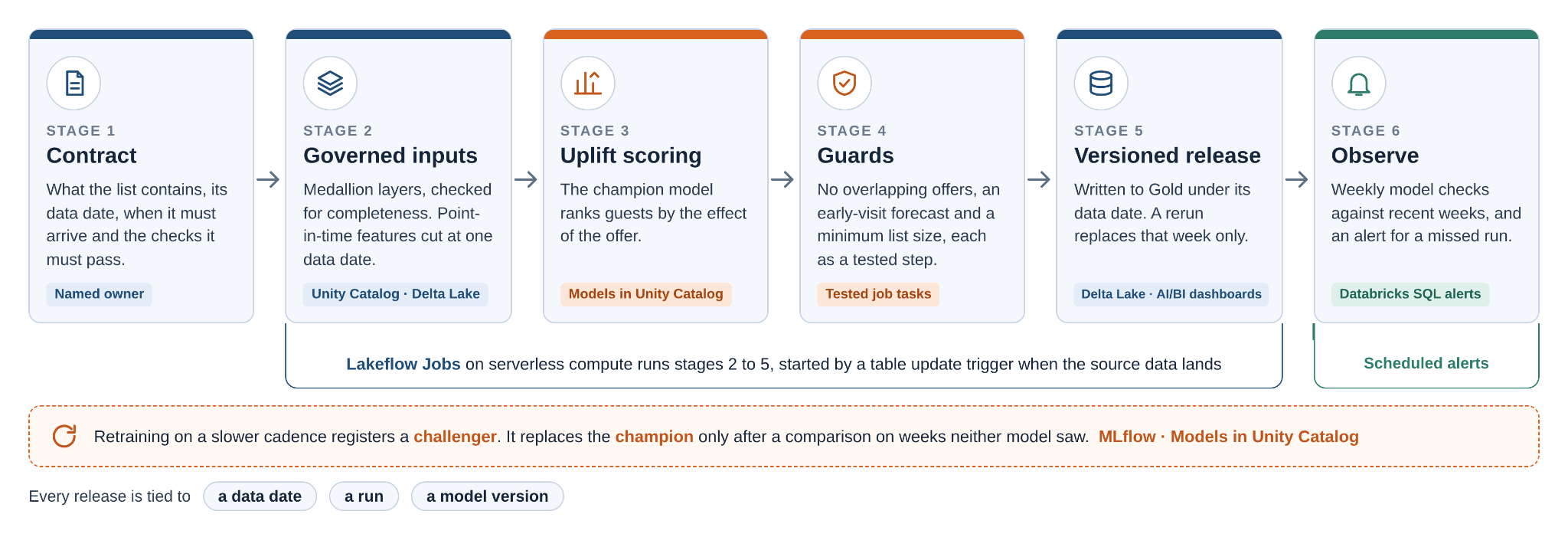
The weekly list as a governed data product: each stage has an owner and a check.
1. A Governed Medallion Foundation
v4c exposes the source warehouse in Databricks Unity Catalog through Lakehouse Federation and lands it in Bronze, Silver and Gold layers on Delta Lake. Each weekly run reads a copy cut at a single data date, so every step of a run works from the same cut of the data. Guest identifiers are hashed before any data science work starts, and each team gets access only to the schemas it needs.
2. Point-in-time Features
Every feature is computed as of the send date. On one engagement only about 10% of the raw columns described guest behavior well enough to build features from. We built candidate features from those and then removed more than half, because they were near-constant, highly correlated with another feature, reproducible from the rest or ruled out by business rules. We also found a loyalty tier field that held each guest’s current tier, which would have shown the model the future during training. The pipeline now checks in code that nothing from after the data date reaches a model input.
3. Uplift Models in Place of Response Models
v4c ranks guests by how much the offer changes their chance of returning. A propensity model corrects for the way past offers were targeted, and an ensemble of meta-learners from causal models estimates each guest’s uplift. The ranking puts first the guests whose behavior the offer changes. It moves offers away from two groups that use budget without a return: guests who will come with or without the offer, and guests the offer does not move at all. Guests who respond worse when contacted are left out.
We also keep what the existing program knows. Where an operator already has a selection rule, we recommend building the list from both. Guests picked by the existing rule and by the uplift model come first, because that overlap is where program experience and the model agree. The model then adds guests the rule missed, and the offers the rule would have sent to the two groups above can be released.
When we measured which inputs both models relied on most, the same small group led: how recently and how often a guest visits, how far behind their usual rhythm they are, and how they responded to past offers.
4. Event-Driven Orchestration with Guards
One Databricks Lakeflow Jobs workflow on serverless compute runs the weekly chain. A table update trigger starts it when the last source table lands. Preflight checks compare the newest day with the same weekday in previous weeks, and the job retries or stops if the data is short.
Selection runs as a funnel of named, tested steps. The first step removes guests the operator has banned or marked do-not-invite, along with guests who have a bad address, before any scoring. Further filters such as residency, recency and visit frequency narrow the field to guests who are past due. After uplift scoring, a protected group of guests is added back based on propensity, and guests forecast to visit before their offer becomes valid are removed. A final guard sets a minimum list size.
One guard came from experience. A program once moved its send by a day, and guests who still held a valid offer reached a draft list. We caught it before the send and rebuilt the guard against overlapping offers to work on any weekday.
5. A Model Lifecycle in Unity Catalog
MLflow records every training run, and v4c registers each model in Unity Catalog under an alias. Weekly scoring loads the champion. A retrained uplift model becomes a challenger only if its saved copy reproduces the run’s scores — a check we added after our first attempt to save the uplift ensemble failed. A person promotes it after a side-by-side comparison on weeks neither model saw. Retraining is scheduled once a quarter, and a scoring run takes about a quarter of the time of a full retrain.
6. Versioned Release and Monitoring
Each week’s list and scores are written to Gold under their own data date, so a rerun replaces that week only. A Databricks AI/BI dashboard refreshes after every run and is emailed with the list. The scoring step also re-tests the champion on the most recent completed sends, and Databricks SQL alerts flag a drop against previous weeks or a run that never happened.
Operational and Business Outcomes
Cost. The design aims the same reinvestment budget at guests the offer can influence, by moving offers away from guests who would have visited anyway and from guests the offer does not move. Compute stays modest because the weekly job only scores.
Speed. The list is ready on send day without anyone starting a notebook, typing a date or watching a data load.
Trust. Every list carries its data date, run and model version, so marketing, analytics and compliance can trace why a guest was included.
For one gaming and entertainment operator whose weekly reactivation list was assembled by hand from several tools, v4c built a governed, self-running list on Databricks in a matter of weeks. That list now builds itself when the data lands, and the operator has extended the work with v4c into a further phase.
What We Watch
- A different list is not yet a better list. A new model will pick different guests from the old process, and that difference alone proves nothing. Before the first send, v4c agrees with marketing how returns will be measured against a control group.
- Future data leaking into training. Fields that hold a guest’s current status, such as loyalty tier, can quietly show the model the future. Point-in-time checks belong in code, not in a reviewer’s memory.
- Responsible gaming. Self-excluded guests, and guests flagged under the operator’s responsible-gaming program, must never reach a reactivation list. Apply that exclusion as a tested rule before scoring and review it with the operator’s compliance team.
- Model drift. Guest behavior changes with seasons and promotions. Re-test the champion every week and promote a challenger only when it wins on weeks neither model saw.
Strategic Key Takeaways
- Give every recurring list an owner and a contract. Write down what it contains, when it must arrive and which checks it must pass.
- Rank by the offer’s effect and combine it with the rule you already have. Keep the guests both agree on, add the ones the model finds, and stop paying for visits that would have happened anyway.
- Score weekly and retrain slowly. A registered champion keeps weekly runs short, and a challenger replaces it only after it wins on weeks neither model saw.
If your team still builds a recurring offer list by hand, v4c can assess it against this pattern and show where a governed, uplift-based list on Databricks would change the result. Reach us at v4c.ai.
About the Authors
Thangabalaji Swamynathan, Chief Technology Officer, v4c
Thangabalaji Swamynathan is Chief Technology Officer at v4c, where he leads data, analytics and AI platform architecture. He has 15+ years of experience designing enterprise data platforms, most recently on Databricks and Snowflake, with a focus on data governance.
Harsh Patel, AI Architect, v4c
Harsh Patel is an AI Architect at v4c, where he drives machine learning and AI solutions on Databricks. He led the strategy, architecture and end-to-end delivery of the engagement this article draws on.
With contributions from Rishab Dugar (Senior Data Scientist), Shreya Santosh Auti (Data Scientist) and Praveen Bhushan (Senior Data Engineer), v4c.
More blog posts