Similarity Is Not Equivalence: What It Takes to Trust Automated Labels in Computational Pathology
Discover how v4c uses Databricks, biomedical embeddings, and governed AI workflows to automate clinical labeling while ensuring accuracy, traceability, and trust in computational pathology.


Summary
- Pathology AI depends on consistent organ, disease and stain labels across slides from many laboratories. As models train on data from more sites, the labeling work grows faster than the people who do it.
- Automation is the obvious answer, and embedding models and LLMs make it easy. They also make it easy to be confidently wrong - because a close match in meaning is not the same as a clinically equivalent term.
- This piece sets out six design principles v4c uses on the Databricks Data Intelligence Platform to automate clinical labeling in a way a quality team can actually trust.
Why this matters now
Computational pathology is moving toward larger models trained on slides from many sites. Every additional laboratory brings its own vocabulary: one writes “colon,” another “large intestine,” a third a local abbreviation. Until those labels are reconciled, they are different categories to a model - and a mislabeled slide is worse than a missing one, because it teaches the model something false.
In many organizations, reconciliation is still a manual task for biomedical data managers. The work doesn’t scale with the number of partners, the judgments aren’t recorded, and nobody can say exactly which labels sat behind a model trained last year.
The temptation is to point a language model at the problem. That speeds things up. Done naively, it also introduces an error that is hard to see: a plausible-sounding label that isn’t quite right.
Six principles for labels a quality team can trust
1. Put partner variation in configuration, not code
Partners will keep sending data their own way. Ingest files with Auto Loader, read every column as text so a format change becomes a data-quality question rather than a pipeline failure, and keep everything partner-specific - file locations, join keys, naming rules - in a single registry table. A new laboratory should be a configuration change, not a project.
2. Run a quality gate before anything clever
Project every partner’s data into one schema, flag the fields a partner doesn’t supply, and quarantine records missing an identifier, organ, disease or stain - with the reason recorded. Spending matching effort on records that can’t be used is waste, and quarantining them silently hides problems. Do neither.
3. Treat similarity as evidence, not proof
Match in tiers, cheapest and most certain first: an exact lookup against the dictionary and past decisions, then a biomedical embedding model, then a language model.
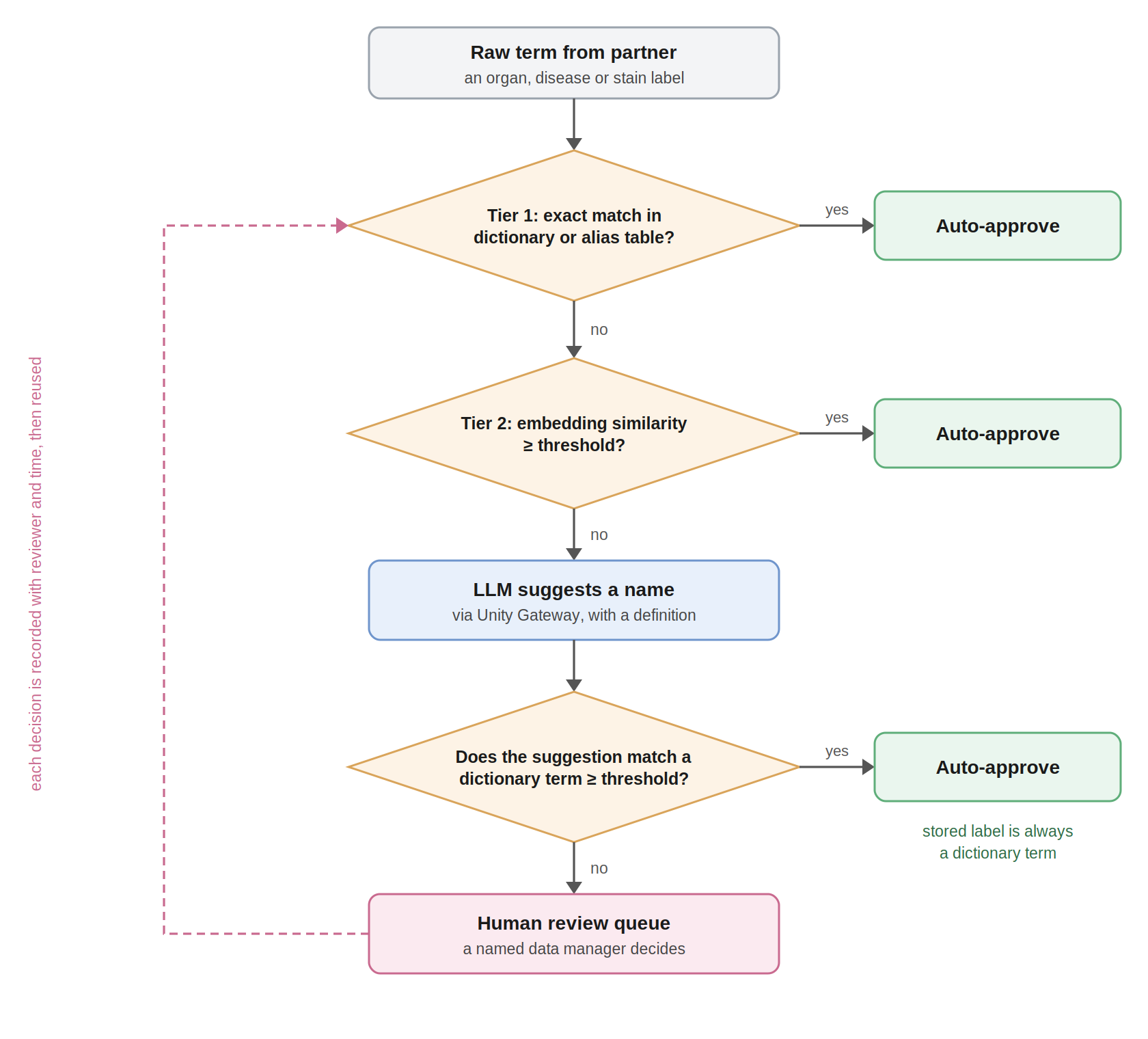
Figure 1: Tiered matching - the language model can suggest, but only the dictionary decides
Two rules make this safe. First, the language model never adds to the vocabulary. Its suggestion is accepted only if it matches an existing dictionary term above the same threshold, so every stored label comes from the controlled vocabulary. Second, a high similarity score is not clinical equivalence. “Lung adenocarcinoma” and “lung carcinoma” sit very close in embedding space but mean different things to a pathologist. Set thresholds high, and - more importantly - measure how often automatic matches agree with expert decisions before trusting them. Where the vocabulary maps to a standard ontology such as SNOMED CT or the NCI Thesaurus, use its hierarchy to catch matches that are close but at the wrong level of detail.
4. Make every human decision attributable and reusable
Send uncertain terms to a review app - Databricks Apps works well - that shows the original term, a suggested definition and the closest candidates on one screen. Record every decision with the reviewer’s identity and a timestamp, then reuse it automatically the next time that term appears. The system doesn’t learn in any machine-learning sense; it simply stops asking people the same question twice. That is less glamorous and far more auditable.
5. Choose your publication gate deliberately
There are two sensible designs, and the right one depends on how the data is used:
- Batch-level gating publishes a batch only when its review queue is clear. Every training dataset is complete and consistent, but one difficult term can delay the whole batch.
- Record-level gating publishes approved records immediately and holds back only the pending ones. Data flows faster, but a dataset built mid-review may be missing records.
For training sets where completeness matters, batch-level gating with prompt review alerts is usually right. For exploratory work, record-level gating keeps engineers moving. Make the choice explicit - and on Databricks, a condition task in Lakeflow Jobs is a simple way to enforce it.
6. Govern the models and the history like the data
It is easy to govern tables carefully and leave the models outside. Route language-model calls through Unity Gateway so they are logged, rate-limited and access-controlled, and register embedding models in Unity Catalog rather than downloading them at every cluster start. At larger vocabularies, Mosaic AI Vector Search is the natural home for similarity lookups.
For history, use Change Data Feed to record before-and-after values for every change, and Unity Catalog row filters and column masks to isolate projects and support blinded studies. For reproducibility, keep training datasets as materialized snapshots referenced from each MLflow run. Delta time travel alone expires with table retention, which is too short for most model lifecycles.
What to measure
Four numbers tell you whether automated labeling is working:
- Accuracy of automatic matches against expert decisions, on a regular sample. This is the number that earns trust.
- Share of terms resolved at each tier. As past decisions accumulate, more terms should resolve at the exact-match tier.
- Review queue age. If publication is gated, this is your critical path.
- Cost per new batch. As more terms resolve at the cheap tiers, fewer reach the language model, so this should fall over time. Measure it rather than assume it.
What we watch
- Thresholds drift in meaning. A threshold that is safe for organ names may be unsafe for disease subtypes. Calibrate per field, not once for everything.
- History is not validation. A complete, attributable decision history supports a regulated process; it doesn’t replace one. Formal validation and regulatory determinations remain with the organization’s quality function.
- Patient data. Confirm what partner metadata contains before ingestion. If anything identifies a patient, de-identification belongs at the very first step.
Getting started
Prerequisites: a controlled vocabulary - ideally mapped to a standard ontology - Unity Catalog in place, and a named data-management owner for uncertain terms. v4c typically starts with one or two partner laboratories, sets up the registry, the tiered matching and the review app, and measures match accuracy against expert decisions before adding more partners.
Key takeaways
- Let the language model suggest, never decide. Only the controlled vocabulary decides what a label can be.
- Measure agreement with experts before you trust a threshold. Similarity is evidence, not proof.
- Make every human decision count twice - once for the record in front of the reviewer, and once for every future record like it.
About the authors
Thangabalaji Swamynathan, Chief Technology Officer, v4c
Thangabalaji Swamynathan is Chief Technology Officer at v4c, where he leads data, analytics and AI platform architecture. He has 15 years of experience designing enterprise data platforms, most recently on Databricks and Snowflake, with a focus on data governance.
Ashish Shrivastva, Senior Data Architect, v4c
Ashish Shrivastva is a Senior Data Architect at v4c, where he designs data and AI platforms on Databricks for healthcare and life sciences clients. He led the architecture of the governed metadata standardization pipeline this article draws on.
Akash Mishra, Associate Data Engineer, v4c
Akash Mishra is an Associate Data Engineer at v4c, where he builds automated and scalable data pipelines on Databricks. He implemented the CI/CD workflows using Databricks Asset Bundles (DABs) that this article draws on.
More blog posts