From Write to Query in 10ms: Breaking the 40-Year Data Divide with Databricks LTAP

For over forty years, there has been a strict architectural compromise whereby operational data (OLTP) and analytical data (OLAP) are kept completely separate. Operational databases have been constructed to support live applications by handling fast, single-row transactions. Analytical warehouses have been designed for scanning billions of rows in order to obtain business intelligence.
To bridge this structural gap, it was necessary to impose a heavy infrastructure tax in the shape of Change Data Capture (CDC) pipelines. If your setup makes use of self-administered Kafka clusters, involves complicated Debezium configurations, or depends on costly third-party replication software, the result is the same: pipelines lead to a basic data latency gap, establish fragmented security boundaries, and break down when faced with sudden changes to the upstream schema.
The impact of this separation is most clearly felt when high-stakes business operations are underway. Suppose you are in a vital financial strategy meeting and an executive requests a full, real-time reconciliation report in order to examine the anomalies that arose from the morning's surge in transactions. In the traditional approach, the response is always something along the lines of, "The ETL job runs at midnight; we'll be able to look at the verified data tomorrow." But with the introduction of Lake Transactional/Analytical Processing (LTAP), this whole approach becomes outdated. Since LTAP unifies transactional and analytical capabilities directly at the storage level without the need for data replication, the validation queries required can be run and sent to the executive team before anyone has even stood up to leave the meeting room.
The Core Blueprint: Storage Fusion and Compute Isolation
Earlier efforts to resolve the transactional-analytical split, especially those promoted as Hybrid Transactional/Analytical Processing (HTAP), failed because of competition for resources. It was common for an HTAP database to consume a large amount of shared CPU and RAM when running a heavy query that involved millions of rows, which in turn deprived the operational application of these resources and caused the live production backend to crash.
LTAP solves this by completely separating compute from storage; it keeps a single logical copy of the data while offering separate compute planes for various workloads.
Why LTAP Succeeds Where Legacy HTAP Failed
Hybrid Transactional/Analytical Processing (HTAP) had promised to overcome the transactional-analytical gap, but the first implementations failed to meet enterprise requirements. In most HTAP architectures, both row-based and columnar engines were placed into a single, monolithic database node; although this approach got rid of ETL pipelines, it brought serious operational drawbacks that LTAP specifically removes:
- Avoiding Resource Conflicts (Compute Isolation): In the case of legacy HTAP, analytical scans are carried out on the same hardware that is also being used for live transactions. A single intensive analytical query is capable of easily depleting the primary database of both CPU and RAM, which in turn causes latency spikes in the production applications. LTAP ensures full physical compute isolation by having operational writes take place on serverless Lakebase computing, while heavy analytics are carried out on separate, dedicated query engines.
- Overcoming Proprietary Lock-In (Open Storage): Instead of keeping data contained within proprietary database storage formats or relying on costly in-memory layers, LTAP uses open standards for storage by having pg_mooncake write transactional data directly into open Parquet files, the metadata for which is managed by Iceberg or Delta Lake.
- Decoupling Scale from Cost (Lakehouse Economics): In the context of Lakehouse Economics, when scaling analytics in traditional HTAP systems, it was necessary to pay for upgrades to the expensive primary database nodes; whereas with LTAP, the raw data is stored in cheap cloud object storage so that write capacity and analytical computing power can each be scaled independently when required.
Architectural Comparison: Legacy HTAP vs. Databricks LTAP
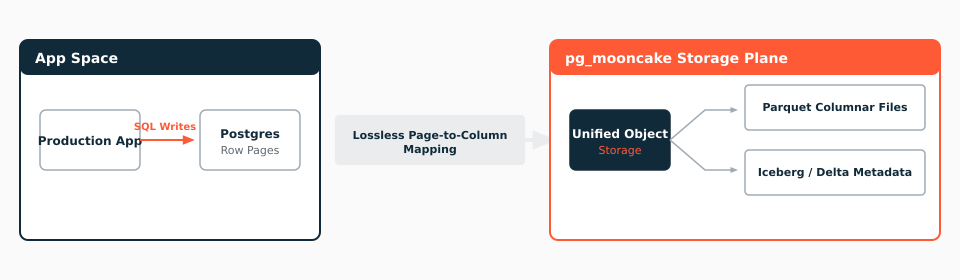
This fusion pattern works because of native storage unification. Whenever the production application sends standard PostgreSQL commands, the writes are directed to Lakebase - Databricks' serverless, fully managed Postgres database, which is built directly on open cloud object storage. Instead of keeping the data in traditional, database-specific storage, an open-source storage framework (pg_mooncake) constantly converts the incoming Postgres database pages into highly optimized columnar Parquet files together with Apache Iceberg or Delta Lake metadata.
Since the compute environments are physically separated, your main web application operates within its own lightweight operational cluster. At the same time, your heavy analytical reporting tools make use of separate Databricks SQL Warehouses or Spark environments in order to read the same storage blocks. Thus, heavy analytics will no longer have an effect on the performance of the production application.
Designing a Zero-Pipeline Real-Time Financial Ledger
To show the practical value of this unified storage layer, let us look at the design of a real-time ledger reconciliation engine. In enterprise financial ecosystems, it is necessary for a ledger to continuously check the stream of incoming transactions in order to detect any attempts at double spending, any discrepancies in balance, or any widespread network outages before transactions are finalized.
Rather than parsing the fragile database logs or forwarding the raw events through intermediate messaging queues, we can set up a continuous audit engine directly within the lakehouse, and each time Lakebase adds an operational transaction, it will commit a new snapshot index to the Iceberg metadata manifest.
In order to ensure that queries respond in less than a second when there is a high level of concurrent access, the read path is directed via Lakehouse//RT, which uses the asynchronous Reyden engine. The Reyden engine reads the original Iceberg storage files directly and achieves processing times as fast as 10 to 100 milliseconds, without the need for a separate caching or serving layer such as Redis.
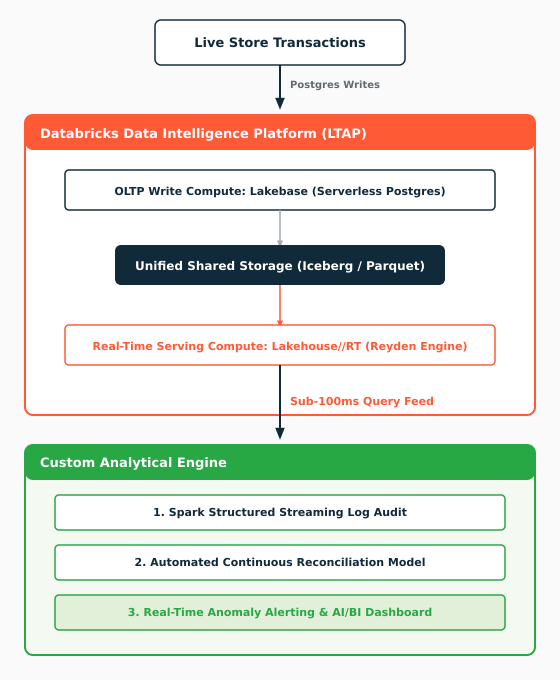
We can establish a self-healing audit loop by directing a Spark Structured Streaming application at the Iceberg metadata directories made available by the Reyden engine layer; the stream omits directory scanning and instead uses the Iceberg manifests to process only the data blocks that have been appended.
The flat, production-focused script below illustrates how this processing loop is implemented:
# 1. Read the live operational Postgres transactions directly via Iceberg metadata
live_transactions = (spark.readStream
    .format("iceberg")
    .load("unity_catalog.lakebase_sync.store_transactions"))

# 2. Apply a 15-minute watermark bound to protect RAM states from late-arriving data
analyzed_stream = (live_transactions
    .withWatermark("transaction_timestamp", "15 minutes")
    .groupBy(
        window("transaction_timestamp", "10 minutes", "1 minute"),
        "account_id", "merchant_id", "amount"
    )
    .count()
    .filter("count > 1")) # Flag immediate double-spending anomalies

# 3. Stream alerts directly into the Gold layer with deterministic checkpointing
query = (analyzed_stream.writeStream
    .format("delta")
    .outputMode("append")
    .option("checkpointLocation", "/mnt/telemetry/checkpoints/ledger_alerts")
    .trigger(processingTime="5 seconds")
    .toTable("unity_catalog.finance_gold.reconciliation_anomalies"))
Production Characteristics of the Architecture
Evaluating this blueprint from a data platform perspective reveals several structural advantages over legacy data engineering patterns:
- Preventing schema poisoning: In traditional CDC setups, the systems often fail when a software engineer upstairs changes the type of a column in production, which in turn causes the downstream pipelines to crash. In this architecture, Unity Catalog is responsible for managing both schema evolution and data contracts, thus ensuring the integrity of the streaming application.
- Stateful Memory Optimization: When it comes to optimizing memory usage, careful management of resources is needed for micro-batch stream groupings. By including .withWatermark(), it is made clear that transaction states that are older than 15 minutes are removed from the RAM of the active cluster. This enables the deduplication engine to run continuously for months without coming across any Out-of-Memory (OOM) anomalies.
- Deterministic Point-In-Time Resiliency: If a cloud instance suffers a physical failure or is restarted, data integrity is maintained. The metadata directory known as checkpointLocation contains the precise state of the Iceberg snapshots that have been processed, enabling the stream to recover and continue without having any duplicate records or missing logs.
Emerging Use Cases for LTAP
While real-time financial ledger auditing provides an immediate return on investment, bridging the transactional-analytical divide opens up novel opportunities across other complex data engineering domains:
- The memory of an autonomous AI Agent involves genAI agents that operate continuous logic loops, having to read, reason, and at the same time update their state variables. Using LTAP, an agent is able to read large-scale contextual knowledge tables through the Reyden engine and at the same time keep its interaction logs committed to Lakebase with a latency of single-digit milliseconds.
- Cybersecurity Threat Correlation: Modern security log monitoring demands that live database mutations are instantly checked against historical indicators of compromise. Engineers can now stream active connection logs straight into an open object store, allowing real-time machine learning models to compare incoming metadata against terabytes of security history without data lag.
- In fleet management and in supply chain networks, GPS telemetry data can be continuously written directly into the lakehouse while separate analytical jobs calculate optimized delivery routing models, matching the current availability of drivers in each region against historical delivery patterns as needed.
Summary
The true impact of Lake Transactional/Analytical Processing is not that it offers a faster pipeline; it is that it renders data movement entirely unnecessary. By building your data stack around open storage foundations shared natively between your transactional application and your real-time query engines, you remove infrastructure complexity, lower cloud computing overhead, and unlock immediate data access across the enterprise.
How v4c.ai Can Help
v4c.ai is a pure-play Databricks services partner with 750+ certifications, 500+ practitioners, and 200+ enterprise clients across Financial Services, Retail, Manufacturing, and Healthcare. We provide deep-dive architectural audits to map out bottlenecks in your legacy OLTP-to-OLAP extraction frameworks and safely transition your infrastructure to a unified LTAP storage layout. Beyond initial setup, we specialize in configuring Lakebase ingestion paths and tuning the asynchronous Reyden Engine to achieve predictable sub-100ms read paths directly from cloud storage without duplicating records into transactional side-caches. Whether you are optimizing cluster resource allocation or implementing stateful watermarks to safeguard memory stability, v4c.ai delivers the hands-on engineering execution required to turn your real-time data strategy into a scalable, serverless reality.
References
- Lake Transactional/Analytical Processing (LTAP) Press Release
- Lakebase Product Page
- Lakehouse//RT Engine and Reyden Launch Announcement
- Real-Time Lakehouse Product Page
.png)