Autopilot Operations with Databricks Genie ZeroOps

.png)
Data engineering teams have become very good at building pipelines, jobs, dashboards, and ML workflows. The harder problem is keeping those assets reliable once production realities set in: upstream schema changes, late-arriving data, quality issues, broken dependencies, and model degradation. Databricks introduced Genie ZeroOps on June 16, 2026, at the Data and AI Summit, as a background agent that monitors production workloads, investigates issues, and suggests fixes that teams can verify. Databricks describes Genie ZeroOps as an agent built into Databricks that monitors data and AI assets, including pipelines, jobs, tables, and ML models.
The significance is clear: GenAI is making it faster to build new data assets, but operations can become the bottleneck. Genie ZeroOps aims to reduce that operational burden by combining platform observability, Unity Catalog lineage, agentic remediation, sandbox validation, and human approval.
Note: Genie ZeroOps is currently in private preview, supporting jobs, pipelines, tables, and ML workloads. To request access, please contact your Databricks account team.
The Strategic Context & Core Features
How does Genie ZeroOps simplify data engineering operations?
Databricks describes the Genie ZeroOps operating loop in four main stages: Detect, Assess, Remediate, and Verify. To ensure proper production control, a subsequent stage of human approval is typically introduced following the verification phase.
Before vs After Architecture
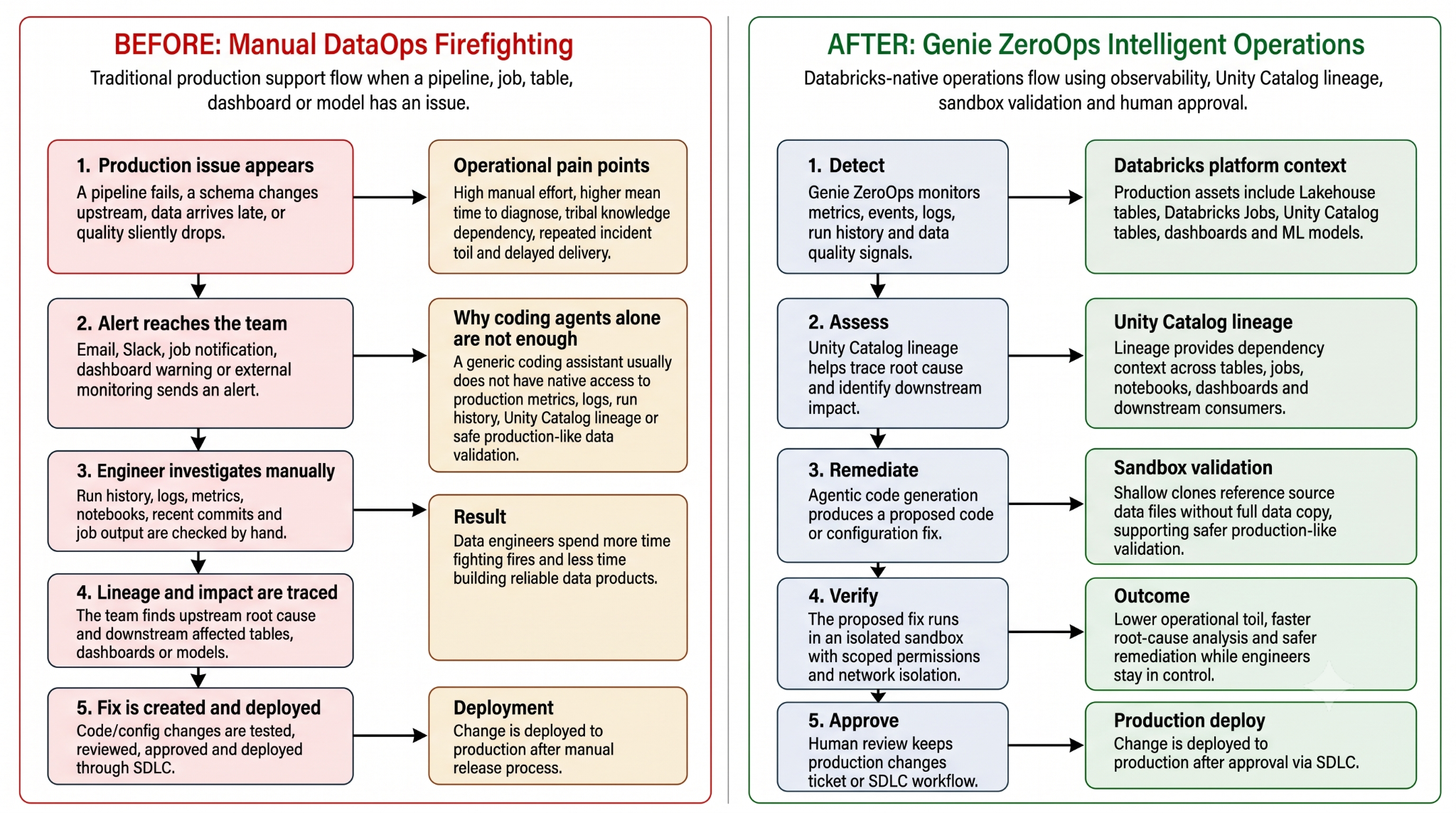
A clear way to explain Genie ZeroOps is by comparing the current manual DataOps approach with the agent-assisted model Databricks is adopting.
Before: Manual DataOps
Before ZeroOps, alerts triggered manual investigations. Engineers reviewed job runs, logs, data quality metrics, lineage views, notebooks, Git history, and ticketing systems. This process was effective but slow, repetitive, and relied heavily on existing platform knowledge.
After: Agent-Assisted Operations with Human Approval
With Genie ZeroOps, Databricks places the agent within the platform, providing access to observability and lineage context. Sandbox validation ensures proposed fixes are tested separately from production until reviewed by a human.
Technical Foundations & System Integration
How does Genie ZeroOps use Unity Catalog lineage?
- Foundation for Operations: Unity Catalog serves as the essential foundation for lineage-aware operations, enabling agents to understand complex dependency contexts.
- Comprehensive Data Tracking: It tracks the full data lifecycle, from source queries and files to transformation jobs, notebooks, and final consumption in dashboards.
- Automated Intelligence: Lineage is captured automatically down to the column-level and aggregated across all workspaces attached to the metastore.
- Operational Benefits: It empowers teams to perform root-cause investigations, trace data divergence upstream, and assess the impact on downstream assets before modifying or deleting them.
Why Lakeflow Matters to the ZeroOps Story
Genie ZeroOps fits within the broader Lakeflow strategy. Databricks defines Lakeflow as a unified data engineering platform for ingestion, transformation, and orchestration within Unity Catalog. Effective agentic operations depend on the context available to the agent. When tools and governance are fragmented, automated root-cause analysis becomes more challenging. Lakeflow provides agents with a trusted, real-time context for data engineering. Databricks integrates Lakeflow Designer, Genie Code, and Genie ZeroOps to create an agentic data engineering experience, enabling visual or AI-assisted development and reducing operational effort with ZeroOps in production.
Technical Foundation: Sandbox Validation and Shallow Clones
Verification is a key strength of Genie ZeroOps. Databricks states that Genie ZeroOps can run proposed fixes in a secure sandbox using zero-copy data clones, scoped permissions, and network isolation, with no changes applied until approval. According to Databricks CLONE documentation, deep clones copy both data and metadata, while shallow clones copy only metadata and reference source data files, using less compute and storage. This distinction is important: sandboxes that validate against production-like data without duplicating entire datasets make remediation safer and faster, especially for large tables. Teams must understand clone permissions, limitations, and supported table types before adopting this approach.
Value Delivery & Execution
Benefits and Real-World Use Cases
The primary benefit of Genie ZeroOps is reduced operational effort. Rather than requiring engineers to manually connect observability, lineage, and code context for each incident, ZeroOps monitors assets, assesses root causes, proposes remediation, and validates fixes prior to human approval.
Technical Readiness and Prerequisites
As Genie ZeroOps was announced as a new Databricks capability in June 2026, teams should confirm availability, enablement steps, and roadmap details with Databricks before planning production dependency. The official Databricks announcement explains the capability, but does not provide guidance on account-specific feature availability. For platform requirements, Unity Catalog lineage only works with tables registered in a Unity Catalog metastore and with supported query or workload patterns. The documentation also notes that viewing lineage requires permissions such as BROWSE on the parent catalog, and that streaming lineage and column lineage in Lakeflow Spark Declarative Pipelines have specific compute requirements. For sandbox validation, shallow clone support has a few limitations and depends on the version in use. Databricks SQL and Databricks Runtime 13.3 LTS and later support shallow cloning with Unity Catalog-managed tables, but streaming tables and materialized views cannot be used as clone sources or targets.
Conclusion
Genie ZeroOps is important because it targets that part of data engineering which often receives the least attention: production operations. By combining observability, Unity Catalog lineage, agentic remediation, sandbox validation, and human approval, it points towards a more scalable operating model for data and AI platforms. The broader aspect is agentic data engineering: Lakeflow provides a unified foundation for ingestion, transformation, and orchestration; Genie Code helps teams build and debug; and Genie ZeroOps extends assistance into production operations. ZeroOps does not mean zero engineering and operational effort. It has fewer repetitive incidents, faster diagnosis, safer remediation, and more time for teams to build trusted data products.
How v4c.ai Can Help
v4c.ai helps organizations prepare for Genie ZeroOps by strengthening the operational foundation around Databricks. This includes Unity Catalog governance, lineage readiness, Lakeflow Jobs standardization, production monitoring patterns, CI/CD alignment, data quality checks, and controlled sandbox validation practices. We identify first adoption candidates, such as critical ingestion pipelines, gold-layer tables, executive dashboards, ML scoring pipelines, and recurring incident categories. The objective is not just to turn on a feature but to create a more reliable operating model for Databricks data products.
References:
More blog posts

.jpeg)